Wednesday, February 17, 2010

Getting talent to favour S'pore over HK

Published February 17, 2010

The Republic must swiftly improve its personal-tax regime to make high-calibre individuals want to settle down here
By OOI BOON JIN

YOU have probably read about the recommendations of Singapore's Economic Strategies Committee (ESC) and its vision of transforming Singapore into a leading global city.
As Singapore stands at the crossroads of reinventing itself, the upcoming Budget next Monday promises to be an exciting indicator of the government's plans to lay the groundwork for this exciting future.
Key among the ESC's proposals is making Singapore a Global-Asia Hub. In line with this goal, is recognising the importance of complementing Singapore's workforce by attracting highly capable and entrepreneurial people to Singapore.

The very recognition of their capabilities suggests that these people are likely to possess highly sought-after skills, know-how or other abilities. They are therefore likely to be highly sought after not only by Singapore, but many other countries.

They are therefore highly mobile and have numerous choices as to where to locate. In Asia, besides Singapore, Hong Kong is often the other location that ranks high on their list of options.

Corporate concerns aside, while each country's tax authorities may want an overall fiscal policy which enhances their country's competitive landscape, the importance of personal tax policy as a deciding factor should not be overlooked.

For many high-calibre individuals, attracting the companies they work for to Singapore must also include another dimension: the location must appeal to them on both the rational and emotional levels.

These high-calibre individuals therefore provide important input into the decisions their companies make on where to locate them - their regional headquarters or branch office.

Besides the usual medley of concerns such as quality of life, amenities and the environment, the personal tax regimes of the countries they are considering could potentially make or break the deal.
At the income levels that these individuals typically command, an uncompetitive personal tax rate may be the proverbial straw that breaks the camel's back. This is especially so when personal taxes directly hit the pockets of the people concerned.

As businesses evaluate their costs of doing business in regional hubs such as Hong Kong and Singapore, the million-dollar question arises: is Singapore a match for Hong Kong in creating a low-personal-tax environment for high-fliers?

Let us measure Singapore against rival Hong Kong. It is interesting to note that our highest personal tax rate of 20 per cent is dismally short of closing the tax gap with Hong Kong, which has a flat rate of 15 per cent.

Coupled with some significant deductions given in Hong Kong - such as home loan interest - Hong Kong's personal-tax regime seems to have the upper hand.

Singapore versus Hong Kong

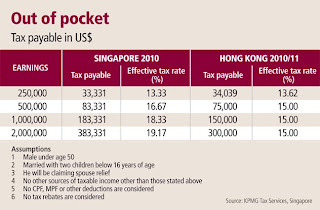
Based on several scenarios and assumptions, KPMG's projections of the variance between Singapore and Hong Kong suggest that the difference is very significant for the highest-earning taxpayers.

For example, a married expatriate individual earning US$2 million per year would pay taxes of US$300,000 in Hong Kong. In Singapore, his tax bill would be about US$383,000. The difference of US$83,000 is about four percentage points.

In a different income bracket, a married expatriate individual earning US$250,000 per year would have about the same take-home pay in Singapore and Hong Kong.

The major assumptions used in the KPMG computations include the following:
> Non-working spouse and two dependent children with its attendant reliefs and allowances
> No pension/social security contributions or benefits-in-kind
> No special tax deductions such as home loan interest.

Doing more for individuals

Singapore has come a long way in trying to bridge the tax gap for such individuals - for example, abolishing estate duty in 2008, as Hong Kong did a year before. This removed the stumbling block which discouraged both foreigners and Singaporeans from locating their assets here.

However, for individuals outside the income brackets illustrated, unless the reduction is in the magnitude of four or five percentage points a year, a smaller reduction may not be immediately felt.
Other measures that the government could therefore also consider include:
Fine-tuning the time apportionment concession under the Not Ordinarily Resident (NOR) scheme to be on par with Hong Kong's time apportionment basis, which does not have a five-year 'life' or a 90 overseas- business-day requirement.

Allowing a tax deduction for mortgage interest incurred by homeowners. Unlike their counterparts in Hong Kong and Taiwan, homeowners in Singapore do not get a tax benefit for the housing loans that they repay every year.

Continuously working to create a more competitive personal-tax environment is one tenet of Singapore's strategy for becoming an Asia Hub. However, it may also be timely to review and improve Singapore's personal-tax regime against that of Hong Kong. This is perhaps most critical in attracting the talents we want to have come and live here.


The writer is executive director and head of international executive services at KPMG in Singapore. The views expressed herein are those of the writer and do not necessarily represent the views of KPMG in Singapore

Tuesday, February 16, 2010

Dead Cat

by Robert Kiyosaki
Friday, February 12, 2010


Dow 5,000 in 2010?

In my last column I predicted a “dead cat bounce” in the stock market and a possible Dow plunge to 5,000 this year. Obviously, many readers mocked my prediction.

But understanding the dead cat bounce is vital, especially in today's market.

Simply put, a dead cat bounce looks like Diagram 1 below:


The market crashes, rebounds, and runs out of steam, then crashes again…unfortunately, and possibly, to a lower low.

When professional investors observe a dead cat forming, many will begin to sell. If their selling leads to a panic, the stock market goes even lower.

Putting today’s numbers to the dead cat diagram gives this topic more meaning.

In 2002, the Dow hit a low of 7,286.

In 2007, the Dow hit a high of 14,164


In 2009 the Dow fell and stopped at 6,547.

Dow 6,547 is where the market stopped falling and the dead cat bounce began. At 6,547 the market was oversold and buyers came rushing back in, looking for bargains. The Dow headed back up, and a bear market rally began.

On February 5, 2010 the Dow closed at 10,012.

On February 12, 2010 the Dow closed at 10,099.

What Does This Mean?

So the question is, “What do these numbers mean to me?” The answer to that question depends upon you. If you are a bullish person, you will be optimistic, reassured by these numbers, and looking forward to the Dow breaking 14,000 soon.
If you are bearish, you will be waiting for the dead cat to finally die and for a double dip recession to begin.

One of the theorists (and writers) I follow is Richard Russell, a wise sage who is in tune with markets and the madness of crowds. He has been in the business for about 50 years, so he has the wisdom and perspective of time. Lately, he has been writing about the ‘50% Rule’ of Dow Theory. I thought I would pass it on to you because it may assist you in seeing the future of the economy, even if --like me -- you do not trade in stocks.

The following is my interpretation of the ‘50% Rule’ using real numbers.

In 2002 the low of the Dow was 7,286.

In 2007 the Dow hit a high of 14,164.

The ‘50% Rule ‘number is 10,725…the halfway point between 7,286 and 14,164.

In 2007, when the market headed down and broke 10,725, professional traders who follow the Dow Theory ‘50% Rule’ knew what was going to happen next. On March 9, 2009, the crash stopped at Dow 6,547.

On that day, what I believe is a ‘dead cat bounce’ began as the market moved up.

On January 19, 2010, the Dow stalled at 10,725 and headed down again. This is spooky. The 50% rule came true.

The next interesting point is 7,286, the low of 2002, when the rally began. According to Russell, if the Dow holds at 7,286 and begins a rally, this might be a good time to buy. But if it fails to hold at 7,286 and slides past 6,547, then look out for dead cats dropping from the sky. Russell predicts that Dow 1,000, the number at which the Dow began its rally in the 1970s, may not be out of the question. If that happens, there will be millions of baby boomers joining the dead cats falling from the sky as their 401(k)s and IRAs implode.

Other Markets

This ‘50% Rule’ may apply to other markets such as gold, the hot commodity of this era.

In 1971 gold was $35 an ounce. I began buying gold in 1972 when I was a pilot in Vietnam, watching the Vietnamese panic when they knew the U.S. was not going to win the war.

Gold hit a peak of $850 an ounce in January of 1980.

Gold dropped to a low of $252 in July of 1999. Obviously, I bought a lot of gold in 1999. Gold was at an all-time low because Central Banks, such as the Fed and the Bank of England, were dumping gold in an attempt to protect the value of their counterfeit currencies.

According to the ‘50% Rule’ of Dow Theory, when the price of gold was passing $600 an ounce(halfway between $850 and $252), a rally in gold was on. When gold passed $600, mainstream financial experts began warning of a crash in the price of gold… stating that gold was in a bubble.

Today gold fluctuates between $1,000 and $1,200 an ounce.

Is Gold in a Bubble?

When you factor in inflation and devaluation of the U.S. dollar, $850 gold in 1980 is $2,500 an ounce in today’s dollars. In other words, gold might be at 50% at $1,200, which is the highest of highs. Could there be a run to $2,500?

Your personal answer to that question will depend upon how confident you are in Fed Chairman Ben Bernanke, President Obama, and Wall Street. If you have faith in our leaders of commerce, don’t buy gold. If you do not have faith in them, maybe you should buy gold or silver.

If the dead cat bounce dies and the Dow drops to 5,000 in 2010, as I predict, then the price of gold and silver may die with the dead cat of the Dow, as investors cling to cash. The next question you need to answer is, “If the Dow dies and the price of gold and silver drop, what should you invest in at the bottom…stocks, gold and silver, or cash?”

I know what I will do. I will buy more gold and silver. Why? The answer is because I trust gold and silver more than Central bankers, the Oval Office, and Wall Street. Gold and silver have been real money for thousands of years.

The Lost Decade

The people I am most concerned about are the average investors who have bought their financial planner’s advice of “Invest for the long term in a well-diversified portfolio of stocks, bonds, and mutual funds.”

Many investors are calling the past 10 years The Lost Decade. That means those who invested for the long term in stocks, bonds, mutual funds, and cash are long-term losers. Japan has been in a Lost Two Decades.

A ‘lost decade’ means:

1. Zero job creation.
2. Zero economic gains for the typical family. Home values are down and many families owe more on their home than the home is worth.
3. Zero gains in the stock market.

Over the next few months, it is important to watch both the Dow and gold. As I write, the Dow is around 10,000 and gold is at $1,000. If the Dow breaks 7,286, the 2002 low, and continues down below 6,547, the 2009 low, watch out below. If 6,547 is broken and gold passes $2,500 an ounce, you'll have even more to worry about.

Monday, February 8, 2010

Joint effort by one and all

Do you agree with the Economic Strategies Committee's strategies and recommendations for transforming Singapore's economy?


Ray Ferguson
Regional CEO, Singapore and Southeast Asia, Standard Chartered Bank


STANDARD Chartered welcomes the proposals put forth by the Economic Strategies Committee (ESC), in particular, to boost productivity, to further promote Singapore as a Global-Asia hub and to grow SMEs in Singapore.

On productivity driven growth:
I believe the proposition to raise productivity through increasing continuous education and training of the workforce has strong merit.

At Standard Chartered, we have always maintained a keen emphasis on training. To support our growth, we have had not only to build our capacity but our capability as well. Hence, it has been important that our employees develop their skills and depth of knowledge.

To build broad-based skills in our employees - akin to the need for 'T-shaped professionals' - we have developed a Learning Centre to build leadership and specialist capabilities in employees.
On Singapore as a Global-Asia hub:

Singapore, with its pro-business policies, clear regulation, robust infrastructure, well educated workforce and excellent connectivity to the region already has much to offer as a hub.

The presence of a number of our group functions in Singapore is testament to this. Singapore is home to our global Consumer Banking and Wholesale Banking business, The Standard Chartered Private Bank, and is also the nerve centre for our global technology and operations functions.

The new propositions would serve to increase attractiveness of Singapore to companies looking to expand beyond their home markets.


Suresh Narayanan
Managing Director, Nestle Singapore (Pte) Ltd


THE recommendations of the ESC, especially in respect of Focus on Productivity gains, development and nurturing of SME's and leveraging the business and habitation advantages of Singapore for MNCs' (both Global and Asian) continue to be relevant and this indicates the 'opportunities' that lie in them.

The rubber hits the road, for success of policy, only when recommendations crystallise into entrepreneurial actions and are sustained over many years. The fact that the three themes mentioned are recurring and have found aa place in earlier economic transformation or competitiveness reports only signals the seminal nature of the ideas therein. I firmly believe that the centrepiece of the transformation that Singapore can look forward to lies in continuous gains in productivity and irrespective of the economic debates that we can have on methodology of measurement, enhancing Productivity questions the input-output processes, re-calibrates competitive advantages and introduces new and robust work practices,skills upgradation and preparedness for newer and more persistent economic challenges. In effect the other key recommendations around SMEs and locational leverage draw their sustenance from the upsides to productivity that corporates and other organisations enable.

The premise that sustained productivity gains will go together with relatively more 'modest' GDP growth of between 3-5% is pragmatic and will set the expectations right in business and society on the quest for 'Quality' growth vs 'Numeric achievements'. The most important signal that business can take out of the ESC is the unimpeachable fact that productivity lies at the 'core' of economic enterprise, and with margin structures becoming wafer thin in a whole host of industries, a vital recipe for sustainable business organisations,(in relative macro economic flux) is the gains that they can make per unit of resource vs alternate locations or business models.

At Nestle,the heartbeat of the organisation is around continuous innovation & renovation and a strong focus on 'productivity' defined on an enterprise wide spectrum. Indeed our Four Pillars of Organisation competitiveness are 'Innovation & Renovation' and 'Operational Excellence' with 'Availability' and 'Relevant Communication' completing the key enablers in our RoadMap for the future. As the world's largest food & nutrition company with a global footprint and a repertoire of household brands, we seek to be the reference company for nutrition, health and wellness which clearly hinges on achieving both innovation excellence and operational competence of a high order. We have embarked upon the 'Nestle Continuous Excellence' initiative globally and this seeks to re-align,re-calibrate and re-focus many aspects of our operations, both manufacturing related and also extending to commercial competence and leadership.

For us in Nestle Singapore continuous innovation and productivity gains have been at the core of our professional lives with highly respected brands like Nestle Milo, Maggi, Nescafe and Kitkat among others continuously evolving as products and propositions in step with the needs and aspirations of the Singaporean consumer.It is also a matter of great pride for us that our factory in Jurong is a 'global facility' for the manufacture of our proprietary Malt Extract that goes to make Nestle Milo. This achievement is clearly not possible without the quantum improvements in productivity through improved manufacturing practices, work methods,technology, work force skills and leadership development that Nestle and our employees have invested in over the last 40 years! It is an example of what 'Cheaper, Better, Faster' is in an actual commercial operation and what is possible in Singapore.

To us therefore the ESC focus on Innovation and Productivity clearly hits the sweet spot as it gives us impetus to carry forward with greater conviction what we have been striving for in Singapore as a commercial entity that will be almost 100 years young soon!

Thursday, July 30, 2009

Shell Q2 profits slump 67%


Shell said production fell five percent to 2.96 million barrels of oil equivalent per day. --PHOTO: REUTERS

LONDON - BRITISH energy giant Royal Dutch Shell said on Thursday that its second-quarter net profit plunged 67 per cent to US3.82 billion (S$5.51 billion) on tumbling crude oil prices.

On a 'current cost of supplies' basis, adjusting for changes in the value of oil held in stock, Shell said profits dived 70 per cent to US$2.34 billion in the three months to June, compared with the same period last year.

Shell said production fell five percent to 2.96 million barrels of oil equivalent per day, as output was hit once again by ongoing violence in Nigeria.

Revenues tumbled 51.4 per cent to US$63.88 billion in the second quarter.

'Our second quarter results were affected by the weak global economy,' said Chief Executive Peter Voser in comments accompanying the release. 'This weakness is creating a difficult environment both in upstream and downstream' operations.

Oil prices struck record peaks above US$147 per barrel in July 2008 but then nosedived as a savage global economic slowdown slashed demand for energy. - AFP

Tuesday, April 28, 2009

Singapore tycoons on rich list

by The Straits Times16 March 2009


Two Singaporean tycoons have made it to the Forbes global list of billionaires.

The magazine estimates Far East Organisation's Ng Teng Fong and family's worth at US$5.5 billion ($8.4 billion) and United Overseas Bank (UOB) Chairman Wee Cho Yaw and family's worth at US$1.9 billion.

Mr Ng, 80, is tied at 87th spot with US trading titan
Stephen Cohen, while Mr Wee is ranked No. 376, alongside 20 others.

Mr Ng, who also owns beverage brand Yeo Hiap Seng, is described by the magazine as 'Singapore's richest man'. The largest part of his fortune is in Tsim Sha Tsui Properties, chaired by eldest son, Robert, in Hong Kong. Son Philip manages family's Singapore business.

Mr Ng, who is married with six children, owns winning racehorses in his Lucky Stable. Known to be frugal, he has apparently lived in the same house for more than three decades, said Forbes.

Mr Wee, the chairman of UOB, started his career at a family-owned commodities business. In 1958, he joined his father's bank - then called United Chinese Bank - and transformed the business from one with a single branch into one hailed as a leading financial institution with more than 500 offices in 18 countries today.

Mr Wee, 80, has five children. His eldest son, Ee Cheong, took over as UOB chief executive in 2007. According to a Forbes magazine report last August, the Wees are the third-richest people in Singapore, with an estimated net worth of US$3.6 billion ($5.4 billion).

In February, Mr Wee and his family donated $30 million to start the Wee Foundation.

Two
Indian tycoons are among the list's top 25 richest. Petrochemical titan Mukesh Ambani is at No. 7 and is said to have net worth of US$19.5 while Lakshmi Mittal, who heads the world's largest steel company is at No. 8 with a net worth of US$19.3 billion. Hong Kong's Lee Ka-Shing is at No. 16 with a net worth of US$16.2 billion.

Sunday, August 17, 2008

Breaking up big banks questioned as losses mount


AP
Saturday August 16, 1:11 am ET By Joe Bel Bruno, AP Business Writer

Deals that created Citi, others questioned as universal bank model shows cracks

NEW YORK (AP) -- America's biggest banks have suffered unprecedented losses from the ongoing credit crisis, and that's made some investors question whether the big financial conglomerates should be broken up in order to survive.

Break-up advocates, who for months have been clamoring for Citigroup Inc. to be dismantled, got some validation of their viewpoint this past week. Europe's UBS AG - created through the combination of Swiss Bank Corp. and Union Bank of Switzerland in 1997 - on Wednesday laid the groundwork to tear up its business model after another quarter of steep losses.

Though the UBS announcement was expected, it was nonetheless a departure from what executives promised during a wave of big bank deals that began in the late 1990s. The creators of global banks like Citigroup, JPMorgan Chase & Co., and HSBC Holdings PLC had promised customers and shareholders that a diverse set of businesses would shield them from economic volatility.

But, those models haven't sheltered the banks from the subprime mortgage crisis that turned into a dislocation of the credit markets. Major global banks have taken more than $300 billion in asset write-downs, and organizations like the International Monetary Fund believe that amount could reach $1 trillion.

"The whole idea was, 'let's be so unbelievably diversified that we won't be affected,' but when the credit markets seize up, no matter what kind of financial company you are, everything seizes up," said William Smith, president of New York-based Smith Asset Management. "The UBS statement basically shows the model is a failure."

That's not what former Citigroup Chief Executive Sanford Weill envisioned when the company was created in 1998 by the combination of Citicorp and Travelers Group. He maintained that offering a mix of financial products -- such as investment banking at Salomon Brothers, brokerage services through Smith Barney, and Citibank's retail and consumer banking -- would protect the company.

Critics like Smith believe that Citigroup is worth more split up. Current CEO Vikram Pandit has rejected the idea, believing the company should come through the credit crisis in one piece.

But, John Reed, who as head of Citicorp forged the deal with Weill's Travelers Group, commented recently that the universal bank model didn't work. That's only been highlighted by Citigroup's stock price, down 71 percent from its 52-week high of $49.

Talk about how Citigroup and others should be structured will only intensify now that UBS appears to have turned its back on its "one bank" strategy. Switzerland's largest bank posted a hefty $5.1 billion write-down for the second quarter, and disclosed plans to separate its ailing investment bank from healthier businesses.

And, concerns about the execution of the business model are spreading, even among those who support the idea of financial conglomerates.

Ladenburg Thalmann's Richard X. Bove, one of the most outspoken banking analysts since the credit crisis began last year, wrote in a note that the "concept behind the creation of JPMorgan Chase has broken down."

Bove said JPMorgan's acquisition of Chicago's Bank One in 2004 was intended to beef up its consumer business, including banking and credit cards. That would help offset problems if the capital markets, like investment banking and related areas, were to falter. The problem is that both markets are currently weak.

He said JPMorgan's exposure was hurt further by the acquisition of crippled Bear Stearns in March. Still, despite all this, Bove feels the model is viable -- and that JPMorgan can work through the troubles over a number of years by cutting costs and refining its businesses.

"No steel company can sell steel when auto manufacturers aren't selling cars, and no bank can make big profits when there's a weakness in the housing and credit markets," he said. "They have to ride out the cycle, minimize the losses, and maximize profits when the cycle returns. You can't restructure a company to avoid that cycle."

"In 1985, there were 14,500 banks in the U.S. - and now there's 7,200," he said. "For the past 23 years, six of them went away each week. The big universal banks might get hit, but they stay in business and come out with a bigger share of the market than they had before."